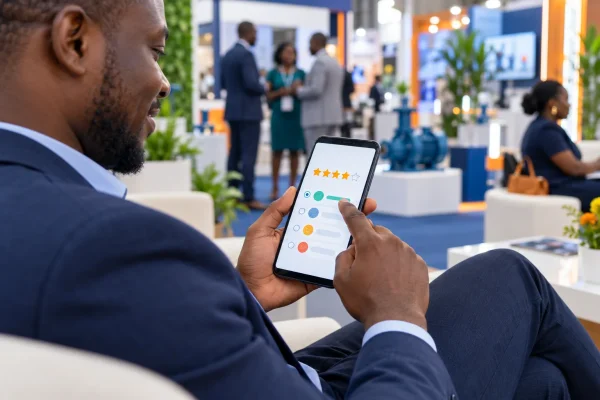
To gather feedback after a trade show, combine three sources within 7 days of the event: an internal debrief with your team, a satisfaction survey sent to the visitors you met, and a numerical review of your results. Together, these give you a complete picture of what worked.
Many exhibitors dismantle their stand the moment the show closes and move on. That is a pity: the lessons from a trade show are at their freshest in the days that follow. In this guide, you will learn how to collect the right feedback, measure your profitability and turn every participation into concrete progress.
How do you gather feedback after a professional trade show?
Timing is critical. Feedback collected more than two weeks after the show loses accuracy, because memories fade and contacts move on. Aim for a structured collection in the 7 to 10 days after closing.
Three sources of feedback to cross-check
Your team on the stand holds a wealth of information: recurring visitor questions, objections heard, peak traffic moments, and elements that attracted or distracted attention. Hold a hot debrief, ideally the day after the show ends, while everyone still has the images fresh in mind.
The visitors and prospects you met are best placed to judge the welcome, the clarity of your offer and the quality of the exchange. Their input is valuable because it reveals the gap between what you think you communicated and what they actually took away.
Your objective data completes the picture: number of qualified contacts, meetings booked, demonstrations delivered, and traffic generated on your website during the event.
Prepare the collection before the show
The best feedback is prepared in advance. Set your numerical goals during preparation, provide a simple way to record each contact (form, tablet, badge scan) and brief your team on the qualification method. Without this foundation, the review remains an impression rather than an analysis. To frame this phase, our article on the reasons to take part in a trade show in Abidjan reviews the goals to set beforehand.
Preparing your next trade show?
Get support from the design stage so that every visit turns into a usable lead.
Talk about my project →Which methods can you use to collect feedback after a trade show?
Each method meets a specific need. The table below helps you choose.
| Method | Audience | Main benefit | Ideal timing |
|---|---|---|---|
| Team debrief | Your staff | Detailed, immediate feedback | D+1 to D+3 |
| Online survey | Visitors and prospects | Quantified, comparable data | D+2 to D+7 |
| Follow-up call | High-potential contacts | In-depth qualitative feedback | D+3 to D+10 |
| Express poll (2 questions) | All contacts | High response rate | D+1 to D+3 |
| Data analysis | Your internal tools | Objective measurement | D+7 |
The team debrief
Bring together everyone who was on the stand for one hour. Ask three simple questions: what worked well, what held you back, and what would you do differently? Write down every answer and sort them by theme: welcome, offer, location, materials, activation. This method costs nothing and often produces the most actionable lessons.
Surveys and satisfaction questionnaires
Sending a satisfaction questionnaire to the contacts you met lets you assess overall satisfaction and spot your weak points. Keep it short: beyond ten questions, the response rate drops. We detail how to build one below.
The follow-up call
For your ten to twenty most promising contacts, a short five-minute call is worth more than ten forms. You pick up nuances that no questionnaire captures, while reviving the commercial relationship.
How do you assess the return on investment after a trade show?
Return on investment is calculated by comparing what the show brought you with what it cost you. The basic formula is simple: (gains attributable to the show minus total costs) divided by total costs, multiplied by 100.
The costs to include
Count everything: booth space rental, stand design and assembly, transport, accommodation, printed materials, activations, and team working time. A forgotten cost skews the calculation and gives you an overly flattering picture. To structure this budget, see our guide to managing your event budget in Abidjan.
The gains to measure
Sales closed during the show are visible right away. Other gains come later: contracts signed in the following months, partnerships started, increased awareness. Track these indicators over 3 to 6 months:
- The number of qualified contacts collected during the event.
- The rate at which these contacts convert into meetings, then into customers.
- The cost per qualified contact, which lets you compare several shows with each other.
- The revenue attributable to contacts from the show.
Non-financial benefits
A trade show also strengthens your image, your relationships with peers and your knowledge of the market. These effects are harder to quantify, but they count in the overall assessment. Note them in your review, even qualitatively. Our analysis of the advantages and drawbacks of trade shows in Côte d’Ivoire details these indirect benefits.
A profitable trade show starts well before it opens
Our team helps you set measurable goals and design a presence that achieves them.
Request a conversation →Which post-show actions should you put in place?
Feedback is only worth something if it triggers action. Here is a simple plan to start as soon as the show closes.
Within 48 hours
Send a personalised thank-you message to every contact you met. Recall the topic of your discussion and propose a precise next step: meeting, quote, demonstration. This fast post-show follow-up makes a difference, because your competitors are often slow to follow up.
Within the first week
Sort your contacts into three categories: hot (imminent project), warm (confirmed interest, distant deadline) and cold (simple curiosity). Assign each category suitable post-show communication: a call for the hot ones, useful content for the warm ones, a newsletter for the cold ones. Also schedule your team debrief and the sending of the questionnaire.
Within the following month
Write a summary report: numerical results, lessons learned, areas for improvement, and recommendations for the next show. Share it with management and the team. Archive it so you can compare your participations from one year to the next. The organisation and planning of your next presence rely directly on this document. To go further, the 11 tips to increase visitor engagement give you concrete ideas to test.
How do you set up a satisfaction questionnaire?
A good questionnaire takes five minutes to answer at most. It asks clear questions, mixes closed answers with a few free-text fields, and is sent at the right time.
The questions to ask
Structure your questionnaire in four blocks:
- Welcome and exchange: was the team available and competent?
- Clarity of the offer: did you understand what we offer?
- Experience on the stand: were the space, activations and materials relevant?
- Desired next step: would you like to be contacted again, and in what form?
Use a 1 to 5 scale for the first three blocks, which makes comparison easier. Finish with an open question: “What could we have done better?”. Free-text answers often hold the most useful ideas.
Best practices for sending
Send the questionnaire by email within 72 hours, with a direct subject line and a single link. State the time needed to answer in the opening message. Send one reminder only, four days later. Thank every respondent and, if possible, share the main conclusions in return: it strengthens the relationship.
Analysing the results
Calculate an average score per block, identify the weakest criteria and cross-check them with your team’s remarks. If several visitors find your offer unclear, the problem probably lies with your materials, not their attention. For upcoming shows, you can also rely on our guide to making your stand a must-see.
Conclusion
Gathering feedback after a trade show is not a formality, it is what makes your next participation better. Remember the essentials:
- Hold the team debrief on D+1.
- Send a short questionnaire within 72 hours.
- Calculate your return on investment with all real costs.
- Follow up with each contact according to their level of interest.
- Archive a summary report to compare your shows.
At Pixlevent, we support companies before, during and after their trade shows in Abidjan. Also discover our projects to see how we design presences that stand out.
Turn your next trade show into a real growth lever
Tell us about your project: we will get back to you quickly with ideas suited to your goals.
Contact Pixlevent →FAQ
When should you send the satisfaction questionnaire after a trade show?
Within 72 hours of the end of the show. After that, the memory of the exchange fades and the response rate drops noticeably. A single reminder, four days later, is enough.
How many questions should a post-show questionnaire contain?
Between 5 and 10 questions, for five minutes of answering at most. Favour rating scales and add a single open question to collect suggestions.
How do you measure the return on investment of a trade show?
Subtract your total costs from your gains attributable to the show, divide the result by total costs, then multiply by 100. Track contacts over 3 to 6 months, because part of the sales close after the event.
Should you also ask for the opinion of the team that was on the stand?
Yes, it is essential. Your staff hear the objections and observe visitor behaviour. A one-hour debrief the very next day often produces the most concrete lessons.