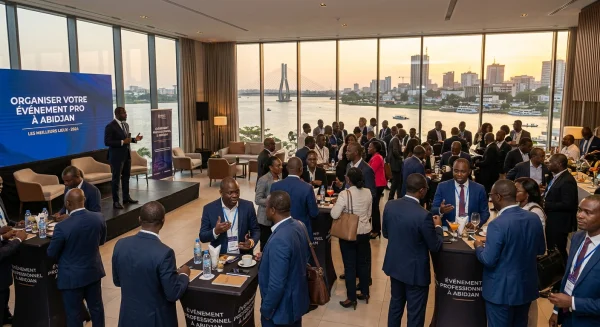
A beautiful venue, abundant flowers, and a DJ are no longer enough to leave a lasting impression. In 2026, event scenography transforms every square meter into a memorable sensory experience. For companies and brands in Abidjan, it has become the key factor that distinguishes a forgettable event from a moment people are still talking about six months later.
Why do all your events look the same and how can you break away from it?
Most corporate events in Abidjan suffer from the same problem: they are well executed, but not truly designed.
You’ve rented a beautiful venue in Cocody or Plateau. You’ve ordered flowers, installed a stage in your brand colors, and planned a cocktail dinner. Everything went smoothly. But three weeks later, your guests would struggle to recall what actually moved or impressed them.
It’s not a matter of budget. It’s a matter of scenography.
Event scenography is not just about aesthetic decoration: it conveys an intention, a message, and a rhythm. It guides the eye, supports movement, and amplifies key moments. Designing scenography means thinking of space as a medium that serves the message.
In other words, everything your guests see, feel, and experience from the moment they walk through the door should be intentional—not accidental. This is exactly what the most ambitious Ivorian companies are beginning to understand and demand from their event providers.
So, what exactly is event scenography in practice?

What are the 5 scenographic trends dominating in 2026?
The codes of high-end events have evolved dramatically. Here is what brands and companies are adopting today.
1. Sensory immersion replaces passive decoration
Spaces that are simply “beautiful to look at” but passive are no longer enough. Events in 2026 focus on immersive experiences through the use of light, sound, and video projections. This approach transforms each space into a true sensory universe, amplifying the emotional impact of the event.
In Abidjan, this often takes the form of video mapping on the walls of a villa or a private venue, custom soundscapes that evolve throughout the evening, or dynamic lighting effects that change according to the key moments of the program.
2. Local greenery as a signature identity
Old trends—such as overly symmetrical dessert tables, excessive dried flowers, or giant balloons—are fading away. The focus now is on spaces where spontaneity and fluidity take precedence.
In Côte d’Ivoire, this trend becomes particularly rich thanks to the country’s botanical heritage. Banana trees, raffia palms, kapok trees, and local orchids offer an exceptional scenographic palette that is authentic and highly distinctive. Integrating these elements into a high-end scenography creates an effect that feels both luxurious and deeply rooted in the local culture.
3. Raw and noble materials in contrast
Raw wood and natural fibers bring an essential tactile dimension to your scenography. Elements in rattan, jute, or linen can be integrated to create harmony with metallic, copper, or golden accents.
This contrast between natural materials and metallic finishes creates a premium aesthetic that works particularly well in the Ivorian context and naturally evokes the codes of contemporary African luxury, a movement that is gaining strong momentum.
4. Spatial storytelling: every zone tells a story
Agencies and brands increasingly seek venues that combine authenticity and innovation, capable of becoming a narrative stage aligned with the brand’s identity.
A pharmaceutical product launch in Abidjan, for example, might design the venue as a “care pathway,” where each zone represents a stage of the brand promise. A fashion brand could create “collection chapters,” each with its own atmosphere. The venue becomes a story that guests physically walk through.
5. Immersive technology as a memorable impact lever
Walls become living canvases thanks to next-generation video mapping technologies. Participants become actors in an interactive narrative where each gesture can influence the unfolding of the experience.
This trend is arriving in Abidjan thanks to a new generation of local and regional technical providers. It is no longer reserved for multinationals, even an event with 80 guests can integrate an immersive projection or a targeted interactive installation.
How to build a memorable scenography step by step
How to Build a Memorable Event Scenography, Step by Step
A strong scenography is designed well in advance—not the week before the event.
Here is the method to follow:
1. Define the emotional brief before the technical brief
What emotion do you want your guests to feel?
Pride? Wonder? Exclusivity? A sense of belonging?
Every project begins with a deep understanding of the client’s context:
What are the key messages? Who is the target audience? What emotions do we want to evoke?
The scenographic concept emerges from the answers to these initial questions.
2. Choose the venue for its potential, not just its capacity
A raw, transformable space often provides far more creative freedom than a ready-made reception hall.
Open-architecture villas, rooftops overlooking the Gulf of Guinea, or renovated warehouses in the Port of Abidjan—these atypical venues allow for the most striking scenographic concepts.
3. Prioritize lighting design
Lighting is the first scenographic tool. It creates the atmosphere even before guests notice anything else.
A well-allocated lighting budget often produces as much, sometimes even more, impact than the same budget spent on generic floral decorations.
4. Integrate Ivorian cultural elements with refinement, not folklore
Wax patterns reinterpreted through projections, gnawa or zouglou music remixed into ambient soundscapes, or local artisans performing live: when treated with care, Ivorian cultural elements create a sense of authenticity that imported decorations simply cannot replicate.
5. Think of scenography as content
Every installation and focal point should be photographable and filmable.
A successful scenography generates content that continues to circulate on social media long after the event—extending the reach of the experience at no additional cost.
This is one of the signatures of our event agency: designing event spaces that live both in person and on screens.
Conclusion: your next event can be the first one people truly remember
Event scenography is not a luxury reserved for major international brands. It is a strategic investment in memorability, brand perception, and the quality of the experience you offer your guests.
In Abidjan—where the event industry is reaching a new level of maturity, companies that move early in this direction build a distinctive brand image: that of an organization that knows how to host, understands the codes of prestige, and respects the time of its guests.
Key Takeaways
- Scenography means using space as a medium, not just decoration
- The 2026 trends prioritize sensory immersion, local greenery, and noble materials
- A strong scenography must be designed in advance, starting with the desired emotion
- When carefully integrated, Ivorian cultural elements become your strongest competitive advantage
- Every well-designed installation also becomes premium social media content
Planning a prestige event in Abidjan?
The Pixlevent team designs custom event scenographies for brands and companies in Côte d’Ivoire. Contact Pixlevent to discuss your next event before the first decisions are made.